(A question from this thread, via the Hathor Legacy)
The thing about "girls don't like [X]" is that they are always redefining what [X] is until that statement becomes partly true.
The Care Bears, My Little Pony, and Strawberry Shortcake are all very much fantasy stories, and, aside from a few fangeeks that are very into one and not the other, most people see SciFi and Fantasy and so analogous to be practically interchangeable. Certainly more interchangeable than Mysteries and Romance novels anyway.
Yet, somehow, I have a feeling that Rainbow Brite would not be on anyone's list of '80s scifi cartoons. I'm willing to bet it wouldn't even be on most people's lists of '80s fantasy cartoons.
Certainly there is a difference between ray-guns and the Care Bear Stare, but the biggest difference between "girl" and "boy" cartoons is not in the storyline or even the amount of action vs. drama (was any '80's cartoon more melodramatic than Robotech? Any 90's cartoon more soap opera-ish than Gargoyles?), but in who the story is marketed to. Which boils down to mostly window dressing and the number of times the weapon of choice is wielded by female characters.
This isn't to say that He-Man was really all that much like Strawberry Shortcake or vice versa, just that they both have equal claims to the fantasy genre, but only one gets used as an defining example of the genre. It gets to the point where The Smurfs and The Gummi Bears are not considered to by definitive examples of fantasy cartoons for kids either, despite the obvious untruth to that statement, simply because they are both less violent and less reflective of stereotypes of adult fantasy than Dungeons and Dragons.
Obviously, all of these strategically shifting definitions make for very circular logic when one then turns around and claims that boys are more into fantasy or scifi.
It's the same kind of effect we get from pretending that women played no part in history until we gained the vote. Ignoring girl's and women's experiences makes it really easy to flat out lie about what girls and women do and like.
Likewise, when one ignores or glosses over the connection between Lord of the Rings and Victorian fairy tales like The Princess and the Goblin, it's really easy to pretend that modern fantasy is completely disconnected from the princess stories my niece likes to act out. Which in turn makes it sound completely ridiculous to suggest that Rainbow Brite was Fantasy (rather than fantasy), much less science fiction.
Kind of the same way that ignoring scientific data makes it really easy to pretend that evolution is all made up.
And yet, aside from the flying horse, is there anything (other than gendered assumptions made by people that never watched the show) that cause us to define it as fantasy, rather than scifi? Or worse yet, fantasy-lite? What makes Teenage Mutant Turtles scifi for kids, but not Rainbow Brite?
Yes, Teenage Mutant Ninja Turtles featured a bit of comic book inspired* radioactive gook in their origin story (which itself is very much a rip-off of the magical elixirs and pools in myths, which is why faatasy and scifi are so often lumped together). But ignore for the moment the rainbows and the martial arts, ignore your prejudices that says that boy = scifi and girl = fantasy. Which of the two characters below looks like they belong in a fantasy? A science fiction story?

Which of these two characters lives on another planet? Cavorts with friendly aliens? Uses technological tools? Fight enemies that use technology as well? Whose story features intergalactic travel? Uses basic physics (light and color) as a thematic metaphor?
Which character uses weapons designed centuries earlier? Whose story features lots of mystical sayings spouted by a Wise Old Man? Who fights enemies that wield mysterious powers? Even the very idea of animals that talk is a very fantasy-like element - despite the scientific origin story.
I like action, adventure, and even violence. And I think that a lot of "girls" cartoons could have done with a bit more actual action and a bit less less running around. More importantly, the writers could have bothered to give their audience more credit for being intelligent. But lets not pretend that quality is what defines something as scfi or fantasy. (If it was, we could simply pretend that the Gor novels have no connection to the genre either.)
Most all, lets not forget that Gummi Bears was not only vastly better than Dungeons and Dragons but also a much better example of Fantasy cartoons for kids.
PS - if anyone feels in the mood to add some more arguments for why Rainbow Brite - or any other "girl" cartoon - was really scifi and not fantasy or anything else, I may feel grateful enough to go digging through old photos and find the one of me all decked out in the incredibly awesome Rainbow Brite costume my mom made for me in third grade. :)
*appropriately enough, since it was originally a comic.
Thursday, May 22, 2008
Is Rainbow Brite Scifi?

Sunday, December 30, 2007
Random Observations and Rantings
Since I started this blog in part to rant about working retail - because I quickly learned that one cannot actually rant to family or friends about working retail (at least when one is middle class) because it will inevitably lead to various iterations of "yeah, but..." - I thought I'd kick off my last week as a bookseller with some random observations/advice from working at a bookstore:
1) When giving a title/author over the phone, always say it slowly and enunciate. The person you are speaking to doesn't have the option of going to the other room where it's quieter.
In fact, this is fairly good advice in the store as well. Your title/author may sound perfectly logical to you, but I promise you that unless you are asking for a bestseller along the lines of The Secret or The Da Vinci Code (NOT the latest one week bestseller from Douglas Preston), your friendly neighborhood bookseller is not likely to hear "for a fueding once more" as "For a Few Demons More."
2) Whoever decided that women are not as visually stimulated as men has never had to clean up the teen mag section of their local bookstore/supermarket. If those 13 year olds thought they could get away with it, those pictures of the Jonas brothers on their walls? Would be completely buck naked. I swear, it's like they have to go over every single inch of every single one of those things every month just hoping they'll get some skin this time. (btw, whotf r jobros n e way?)
3) The most recent issue of Bitch? We got enough to warrant a full, unencumbered, out to edge, front row, eye-level slot on the magazine rack this time. awesome
4) When looking for a book in the children's section with "love" in the title, have either the exact title or the author. Preferably both. "But I saw it at Walmart and it had a cover with bears hugging..." Does NOT cut it and will just make me hate you. Do you have any idea how may books we have in the store that fit that description? Much less in the search database?
5) Do not, under any circumstances, answer "Are you finding everything ok?" With "Not my wife/husband/friends!" Your friendly neighborhood bookseller may cease to even remotely friendly at this point. And I swear, if one more person answers with "Not my kids!" I swear I am going to smack them. How the fuck am I supposed to know you mean your 16 year old and not your 4 year old? On second thought, I think I'm just going to look all panicked and immediately ask for a detailed description of the kid(s).
6) That "never" goes double for making cracks about stuff being free when we can't get the scanners to work. Making fun of us isn't going to endear you to us or make us think you ought to have your own sitcom. We are just going to think you are a jerk and pathetically unoriginal.
7) It's also not funny or nice when you joke about working at a bookstore actually entailing work. That's right up with there with the people who proclaim "I'd love to work here! I'd read books all day!" (You can do that now, you know...and get paid pretty much the same.....since you'd be fired before your first day was over. Presuming you made it past the interview.....)
I know it sounds like you are being sympathetic, but all you are doing is making more work for me - because yes, smiling while I pick up, for the umpteenth time, the dozens of millimeter thin chapter books that someone decided would stand upright on a shelf - that is work. Especially if what I am pretending to smile at is someone commenting on how much my job must suck while they just stand there and watch me do it. That's why they can fire me for simply failing to be friendly enough.* So, I may not hate you as much as I hate the idiots that decide to answer "can I help you?" with a question that belongs in Deep Thoughts, but I certainly don't think that you are funny. And if you are trying to be kind, you are failing miserably.
8) Speaking of jerks and jokes made at the expense of people who have very little power - I stopped laughing at your dumb jokes last year when retail ceased to be my primary source of income. Yeah, you don't like that too well, do you?
9) Um....it's two days before Christmas, and we consistently do several thousand better that just about any other bookstore in the area on a normal day. We don't have shit. (No, seriously. We ran out of Goosebumps books this year, of all things.) Yeah, I know that the Riverside store does. Riverside still has copies because no one shops at Riverside. Why? Because they don't answer the effing phones for one....but if you'd like me to call them and have them put it on hold for you....
10) It's two days until Christmas. And Christmas is on a Tuesday this year. That makes today a Sunday. No, we cannot order it today and have it in before we close at 6 pm tomorrow.
11) "But it's cheaper on the website." Yes, that's because the website does not involve paying people like me.
12) I don't expect you to take my advice, but when you ask for it, and both I and the preteen fantasy fan** standing next to us advise you not to give your nine-year old daughter Tolkien as her first fantasy novel, I am a little miffed that you go ahead and get her The Hobbit anyway.
Now I, personally, loved The Hobbit at the tender age of 9***. However, I'd already read A Wrinkle in Time (et al), The Chronicle of Prydain, The Chronicles of Narnia, and The Princess and the Goblin****. I may have even read The Blue Sword and The Hero and the Crown. In other words, lots and lots of fantasy books that actually have girls in them. But, please, do go on ahead and make your daughter's first introduction to fantasy a book that doesn't just feature a male protagonist (as does The Chronicles of Prydain) but is pretty much devoid of women and girls altogether. I'm sure that will go over quite well. Especially since it was clear that she would be reading it, rather than the two of you reading it together.
The Hobbit rocks. It also seems to think that girls are creatures more mythical and less likely than dragons. Methinks there are better first fantasy novels out there - for boys and girls. But wtf do I know.
13) Dear god, either my coworkers don't know the alphabet or they don't even bother to look. (Which, ok, Christmas, I can't really blame them.) I finally found 1 of our 2 copies of A Companion to Wolves next to The Princess Bride. I suppose I ought to thankful that it was in SciFi/Fantasy.
That's all for now, but I'm sure I'll have more. :)
*technically, I think I need to do more than that, but they can certainly cut my hours to the point where they might as well have fired me.
**I was initially just going to answer his question of "which cover would she like better?" Because I know better than to argue with customers that have that look in their eyes. The "I loved this as a kid and my kid will too!" look. (Yes, and that story your tell you kids to make them go to sleep will one day be a bestselling picture book!)
It was the 12 (?) year old girl that overheard our conversation that first suggested he pick something else.
***I may have actually been 10. But the point still remains.
****Too bad we didn't have that one in stock, I might have been able to persuade to him to see reason by telling him that George MacDonald's children's books were an inspiration to Tolkien. It also would have been fun watching him pretend to have already known that. Cuz tons of boys read MacDonald's stories nowadays.
And yes, I know I'm assuming that I know his daughter better than he does. But if he wasn't sure about the gift, he wouldn't have asked me for advice in the first place. He didn't give a damn about the covers, he just wanted me to tell him it was a fantastic idea. And possibly to brag about his daughter's literary feats.
Thursday, December 27, 2007
The Things You Discover When You Should Be Sleeping
1) There are over 4,000 fan fiction stories based on the Animorphs series posted to fanfiction.net.
That makes it #6 in books.
What are numbers 1-5, you ask?
Well, you don't really need to be told that Harry Potter is #1
Lord of the Rings is #2
Twilight is #3
The Phantom of the Opera is #4
Tamora Pierce is #5
2) There are 9 stories posted to fanfiction.net based on The Princess and the Goblin
What the hell kind of fan fiction does one write about The Princess and the Goblin?
Apparently, several are sequels written by people unaware that there is an actual sequel. Or that didn't get it. (Just for the record, I loved it. I was, however, no more than 10 at the time, if that matters.)
3) Someone made a movie? MUST SEE!
Final Thought: I'm amused by the number of stories on fanfiction.net based on Eragon. Isn't that a bit redundant? Fan fiction based on Eragon, I mean?
Thursday, August 16, 2007
16th Feminist SF Carnival
Welcome to the 16th Carnival of Feminist Science Fiction and Fantasy Fans!
Before we start, I have a confession to make.
I like science fiction, I really do. Fantasy too. I like the world-building and the hypothetical plots, the technology and the magic. All the things that make it science fiction and/or fantasy instead of something else.
But I have to admit that part of my love for scifi/fantasy is really a love for action heroes. More specifically, female action heroes. I spent a lot of time as a kid looking for adventure stories that featured - or at least included - girls, and a lot of them ended up being science fiction and/or fantasy stories. Women with swords, girls with magical powers, heroines with blasters. For some reason, leaving this world behind and building another made it easier for writers - and their audiences - to wrap their head around the idea that girls could love action and adventure.
When I was younger, the main obstacle to finding girl heroes seemed to be the relative lack of them. As I got older, I kept running into the uspoken and rarely broken rule that, when they existed, action heroines must be sexbots first and action heroes last. So when I stumbled across the Ask.com commercial featuring "chicks with swords" (via The Hathor Legacy), I knew that had to be the theme when I hosted the carnival.
So without further ado, here is the 16th Carnival of Feminist Science Fiction and Fantasy Fans, chock filled with sword carrying women and all kinds of other great - or not so great - stuff.
It's a bird. It's a plane....it's Supergirl!
My thoughts on the new incarnation of Supergirl lean towards gibberish along the lines of "Pretty. Shiny. Me like. Me want more."
Fortunately, others have been much more loquacious than I.
First off, ami at Super Cute Rants of DOOM XD (totally the best blog title ever) writes about why she loves Supergirl:
Why do all heroes have to be angsty and mean? Why do they all need "reasons" to be heroes?Indeed, why must heroes always have "motivation"? I like characters with depth, but I don't think that means their reason for being good always needs to be complex.
Can't we have some heroes who are just good ppl and dun have to become good ppl?
Why do girls need to be abused or live on the streets or be hookers in order to be heroes?
Can't they just crash land on a planet and be a hero? :D
...
Aren't we even allowed a few happy heroes? :)
Anyway, back to Supergirl.
Kalinara is one of the many who loves the latest issue of Supergirl:
Yes. Thank you.
That's what a real teenaged girl looks like. That's even what a real teenaged girl wears....She looks amazing.....Bedard's character is one I want to read about. Guedes's is one I want to see.
Brown Betty's praise is simple but oh so true for oh so many of us:
I just look at it and *siiiiiiiigh* with happiness.
A lot of the gushing over Guedes' art and Bedard's writing has happened in the forums, so I thought I'd include a few quotes from the ones hosted by Girl-Wonder.org (which I'm not sure is technically allowed, but I love this Supergirl so much I don't care!):
I have all-around feelings of joy for this issue. ^^-Linkara
At last, fantastic artwork (only one upskirt shot and it didn't feel like fanservice because of the shorts!). And Supergirl actually tried to do something to fix her mistakes instead of just wallowing in it.
I loved this issue so hard. Supergirl - and the other characters! - looked human, and instead of sulking about her mistakes, which were so very much those of a superpowered teenager with a lot of naivety, she tried to do something about them.-KPhoebe
For sure, the art in this was WONDERFUL. And I love how Supergirl and Wondergirl, despite both having blue eyes and blond hair, actually LOOK like two different women.... I really like how Supergirl is obviously a very young girl who is trying really hard to be a good hero.-Caribou23
Which brings us to the very sad news that a new creative team has been announced for Supergirl (via Occasional Superheroine)
Crash! SMASH! KABOOM!
(sorry for the interruption, that was my house blowing apart from the sheer amount of despair and rage inside my brain)
However, that doesn't mean that you shouldn't still write to DC (if you haven't already) and tell them how much you are loving Guedes' and Bedard's Supergirl. Occasional Superheroine has some tips. (If you do, please keep in mind that Guedes' and Bedard's run was always meant to be temporary. Their departure is not (necessarily) a reaction to the idiots who think that Guedes' Supergirl is fat.)
Hermione is always right, unless she's being emotional.
(needless to say, do not click any of the links unless you've finished the series or don't mind spoilers.)
Over at Capitalism Bad, Tree Pretty, Maia hones in on one of the main complaints I've been hearing about Deathly Hallows:
'I'm going to leave you because I'm putting you in danger' is my least favourite relationship device ever.....What I find so frustrating about this, is that limiting women's choices for them is portrayed as a romantic act....Loving someone shouldn't mean limiting their agency.
*e, at A Blog Without A Bicycle, ponders the newest movie villian and brings up a good point:
"...I just wish that it wasn't her (overly) stereotypical "feminine" traits that made [Umbridge] so memorable. What if a female villan was just...villanous?"
I'll admit to being one of the many who enjoyed Imelda Staunton's Umbridge, but it does bring up the classic feminist dilemma when it comes to femininity: how does one analyze the limitations created by traditional femininity, or create a feminine villian, without bashing femininity itself? Hopefully with more finesse than the movie manages to have.
Sara of Sara Speaking discovers that sometimes gems do lurk within Amazon forums, after stumbling across this excellent question about power and gender in Potterverse:
I can understand how men would be better at physical fighting than women, but simply waving a wand in the air using spells based on pure intelligence….??? Hello?????......Where was the female equivalent of Dumbledore?Sara adds:
I find it a very valid question, especially since it’s a fantasy book. Why should it have to conform so closely to the male-dominant standards of the society we already have?....And why, oh why, is it called the wizarding world — when there is a clear gender-based differences between wizards (men) and witches (women)?
I think that fireeyedgirl sums up a lot of feminist fans' feelings towards the series as a whole when she writes that
I don't hate the Harry Potter books because of [it's treatment of female characters], I just am sad because I feel like there was potential in this series, written by a woman who is also the mother of a daughter, for a rebel girl heroine who breaks rules and succeeds.
All of which makes it that much sweeter to learn (via Jessica at Feministing) that Emma Watson, the talented young woman made famous by her role as the always clever Hermione Granger, considers herself to be "a bit of a feminist."
And on that note, Sara also points us to an illustration by makani of one of the few showdowns between female characters in the series.
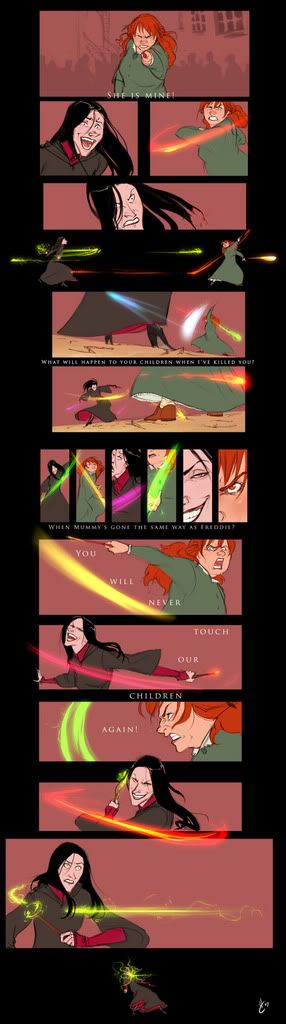
"No....there is another."
There's a great article over at Jive Magazine about why "Star Wars fans hate Star Wars."
Never is this more true than when it comes to feminist fangirls who love Leia. (ie people like me) The knowledge that Leia was capable of becoming a Jedi, and yet was not the one who brought about the Return of the Jedi epitomizes why being a feminist SF fan is often a bittersweet experience.
Princess Leia was My First Idol, my first hero, the kind of princess I've always wanted to be.
She didn't just wait around and pray to be rescued.....[and] She told the scary bad guy that had us all quaking in our boots to fuck off.
And guess who else loves Leia:

“Outta my way, nerf-herders. Guess it’s up to me to save our skins—again! ZAP!”- from the always amusing mind of Meg Cabot.
No wonder why Mia is such an awesome princess.
Also, fellow Star Wars fan Sarah (Still Life With Soup Can) made some cool shirts for herself at Cafe Press and was surprised when other people bought them. I'm not surprised that the most popular are her Girl Revan shirts mocking "LucasFolk['s decision] to go and ruin the fun by declaring "Canon Revan" to be a light side male." Revan being a playable character in various Star Wars games, for the two people other than me who are unfamiliar with the name.
"It Slices, it Dices, and Makes Julienne Preacher." - And Other Sharp, Shiny Objects
Yes, I know Buffy's signature weapon was a wooden stake, but let's face it, we all loved her best when she was wielding something sharper than the pointy end of a picket fence. Which may be why Grace's summation of the best and worst of Buffy at Heroine Content features Buffy with a sword, not a stake. Like me, Grace
didn't watch Buffy the Vampire Slayer when it was first aired...[does]not believe the show deteriorated when it moved to the UPN.... [and] loved it from start to finish...she adds
All that being said, I've never seen anything on television so in need of feminist and anti-racist analysis as Buffy. The show gives a whole new meaning to the phrase, "so close but so far away."
At 100LittleDolls, Shions_Glasses also reminds us that sexism often goes hand in hand with racism. (warning: spoilers for Rogue Galaxy within)
Of course the only woman of color in the game has to hail from a "backwards" tribal jungle planet. .....On top of that, her bow is pretty worthless in combat.Obviously, Lilika deserves better clothes, a better backstory, and a better weapon. XD
A sword, maybe? ; I
Amber Night finds yet another fantasy game with sword-wielding women sporting unlikely armor.
in the world of WAR, do they just go for the legs? ....You could make an entire suit of normal armor just out of her leg armor. Which…you know…probably would have been a good idea, given that her guild seems to be short on armorers able to craft from the crotch up.
Meanwhile, Tekanji uses a picture of a sword carrying girl to demonstrate (at Shrub.com) the dangers of assuming that your good intentions will mean your message is clear, even when the context is ambiguous. (I'm not going to quote the posts because it's more of an audience participation experiment. Just follow the links. It will take you to the girl and her bloody sword and explain who she is.)
"We rule Terabithia, and nothing crushes us!"
Alice, at Wonderland gives us some pictures of the incredibly awesome woman who won BlizzCon's costume contest, and her kickass getup.
BomberGirl (Girl in the Machine) talks about why she loves Heather from Silent Hill:
Throughout her story, we come to root for Heather. She's not perfect; she has flaws, from her short temper to the freckles on her face. She stands as my most favorite video game character of all time (just take a look at my icon!). And here at Girl in the Machine, game developers hand us so much to be negative about, and it feels wonderful to celebrate the positive aspects of women in games.
Kotetsu gives favorable reviews to two recent anime movies, Paprika and Toki wo Kakeru Shoujo. Regarding the former, she writes:
One thing that I love about Paprika, however, is the heroine....Like in all of Kon's movies, a woman takes center stage. Sure, there are lots of male characters, and sure, they're important - but they're only important in the sense that they interact with and support the heroine. It's almost the complete opposite of most Hollywood (and Japanese) movies.
Lyle, at Crocodile Caucus lets us know about an interesting possibility on the upcoming season of Supernatural:
Unfortunately, one thing that’s always kept me from fully getting into Supernatural is the show’s WiR-ness......Now, an interview with series creator Eric Kripke gets me excited about Supernatural for the first time. There’s no money quote, but, at the least Kripke shows an awareness of the problem and seems like he’s looking to correct the course.
Lastly, I'm apparently not the only one that adored Spider-man, Fairytales #1. Pervyficgirl writes:
I love this comic. Possibly I read it six times. Possibly I will be sharing with my eight year old niece. Something I dearly wish I could do in good conscience with Black Canary or current Wonder Woman.
Also, it is implied that Peter is going to make his Spider-costume out of the remains of MJ's red hood. Awwwwww. I love you, Peter Parker. You wear your strong woman's clothes.
"It's just so illogical, you know, about being a Smurf... what's the point of living... if you don't have a dick?"
The latest version of the Smurfette Syndrome is brought to us by the new Transformers movie. Ragnell eloquently rants:
Why is being a girl so fucking special? Why is it that every other fucking robot has a male fucking voice and no one questions why they have gender coding but the fucking second you bring in a female voice and god forbid you put it in a feminine color you have to suddenly explain why everyone has gender?Amen!
And the next time someone tries to argue that it's all because girls don't like action and explosions and the like, feel free to spit out the stats from a recent study that says otherwise. Mighty Ponygirl (from Feminist Gamers) summarizes:
While the numbers still show that boys play more videogames than girls, the gap is not as wide as people would like to believe: while 2/3 of boys reported playing a violent video game at least once a week, so did a full 1/3 of girls interviewed. This means that even the remaining 2/3 of girls who play videogames may still play violent videogames, just not as often as once a week.
On a more "high-brow" note, Eleanor at Ambling Along an Aqueduct has some thoughts on why there don't seem to be as many female SF writers:
I think there is a double prejudice operating here. One is a prejudice against the life sciences as opposed to physics and engineering.....The other, of course being that it can't really be "hard" SciFi if it was written by a woman. (Women being soft and gooey and all, I guess.)
Charleanders at She's Such a Geek! asks us to help Free Julie Delpy!. She also asks:
Why does Steven Spielberg get to make dozens of increasingly braindead films, when Julie Delpy doesn’t get her shot?Good question!
On a similar note, while the statistics are not about Science Fiction/Fantasy in particular, gillpolack points us to some interesting, but depressing, stats on gender in movies:
72% of speaking character parts are male;Ouch. I can't imagine the stats are better when one looks at just scifi/fantasy.
83.5% of crowd scenes are male;
83% of narrators are male.
(note: the link to See Jane's research seems to be broken. Their site is currently being reworked, and that may be why. I'll try fix the link when/if I can.)
At Feminist SF - The Blog! lizzard let's us know that
Juno Books’s Paula Guran is looking for stories for Warrior Women [a reprint anthology]...Amazons to warrior princesses to space cadets—strong women who meet the challenge of fighting the good fight.If you have any suggestions - send them in!
I'll admit that I don't know much about LiveJournal, and many of the postings about the recent controversy over LJ banning various fandoms and fanfiction journals has left me more confused than enlightened. However, Mastor Erestor has some strong words to say on the subject:
"Obscenity" is the perfect tool to weed out everything that doesn't fit in a nice, clean, straight, male-dominated and preferably white world.(sigh) Isn't that always the case.
Ahh! Curse Your Sudden But Inevitable Betrayal!
Bellatrys, at Nothing New Under the Sun, takes one for the team and reviews the first two Gor books. Her reason?
After about the fifth or sixth reiteration of the (usually-male-made) claim that "the first ones weren't so bad, the misogyny and male dominance stuff didn't come in till later," I resolved, in my Chaotic way, to challenge this dogma and put it to the test.What she finds is scary in so many ways.
While I'm sure everyone knows by now just why the lamentable Gor series is getting more dicsussion lately, it should also be noted that, as J. E. Remy (Die Wachen) points out, apparently
Dark Horse feels it not only appropriate to support the subjugation and victimization of women by republishing this long out-of-print work, but to market it to “all age groups.”(emphasis mine)
Remy's posts critiquing Dark Horse's decision also include all kinds of contact information in case you want to write letters to the parties involved.
Because I cannot end this on a bad note, I leave you with 1) Space Invaders Against Sexism!
(Yes, it's from kotaku - but it's space invaders against sexism! - and it's via Jade Reporting. I think......It's been a long couple of days.)
And 2) a reminder that Ragnell is still looking for someone to host the 17th carnival.
That's all folks, thanks for coming!
Wednesday, August 01, 2007
Part 2: The Power of Myth
A review/analysis of Into the Wild by Sarah Beth Durst
(Go here for the Intro and links to Part I and beyond.)
As the back of the books says: "Beware the Wild - it bites..."
So, you know how I said in the last post that it would contain spoilers? That goes double for these next two. Seriously. I'm going to give away the two big twists, so DO NOT READ THIS UNTIL YOU'VE READ THE BOOK!
Part I: Mothers and Daughters
A review/analysis of Into the Wild by Sarah Beth Durst
(Go here for the Intro and links to Part II and beyond.)
One of the things I've noticed lately is that when movies and TV shows want to depict a meaningful but complex relationship between a parent and an adult/older child, the parent is almost always a father. At least outside of "chick flicks," anyway. (In fact, that rather seems to be the definition of a "chick flick" - a movie that is about the relationships between women, rather than the relationships that men have.)
I think that part of the reason that a lot of girls and women are drawn to fairy tales is because the opposite is true. While the characters in traditional fairy tales are often one dimensional and not always the best representations of women, the relationships in fairy tales tend to include a lot of mothers. Cinderella, Hansel and Gretal, Snow White, Rapunzel, Sleeping Beauty...while the mother figure is often an evil one, at least she is there, making the stories usually about girls with mommy issues, not boys with daddy issues.
Sometimes there are even other adult women - good and bad - who figure prominently in the story. And they aren't all bad; in Little Red Riding Hood, it is Red's positive relationships with the adult women in her life that provides the catalyst needed for the story to start. (Despite the paternalistic tone of the version most of us grew up with.)
WARNING - massive spoilers below the cut!
Her mom smiled, and Julie grinned back. And for an instant, everything was ok.
The same is true of Into the Wild. Julie's story begins with Julie having to deal with being her mother's daughter and how that isn't always easy. Julie also accepts the call to adventure solely because of her emotional ties to her mother, Rapunzel, and her grandmother. And as we all know, it was Rapunzel's mother who provided the conflict needed for her story to begin as well . While not important to the plot of the story, this tidbit makes it clear that Julie's relationship with Zel, although special, is not unique. Julie's story is part of a larger pattern, and this connection to the cycle of mothers and daughters makes her journey more meaningful, not less so.
So it's no surprise that Sarah Beth Durst dedicated the story to her mother and her daughter. In interviews, Durst has talked about free will being one of the main themes of the book, and it is. The relationships between women is another one. Throughout the story, female friends of Julie and Zel act as helpers and guides, and the relationship between Julie and her mother is central to the action that takes place.
Zel sighed. Sometimes she understood why her own adoptive mother had locked her in a tower. It was hard to watch the person she loved more than her own life grow distant. Each time her daughter rolled her eyes at her, Zel felt her heart twist. She didn't want to wait nine or ten years for Julie to like her again.
Durst does a very good job of not only showing the conflict between Julie, who just wants to fit in, and Rapunzel, who is afraid of losing her daughter to the abyss of teenager's inner turnoil, but also of depicting it in such a way as to make both characters sympathetic to readers of all ages. While most of the story is shown from Julie's point of view, the entire second chapter is spent shadowing Rapunzel instead as she goes about her daily routine at the Salon. This not only provides some necessary world building, as Julie's understanding of the Wild and the past is patchy at best, it also allows kids to step into Rapunzel's shoes and see her as a person and not just a mother archetype.
When Zel and Julie fight, we feel for both. When Julie wonders if she is the cause of her mother's capture by The Wild, we can all empathize with having wished our parents gone at some point, despite the fact that such a wish would mean our deepest fears as well. And even if we haven't been a mother ourselves, we can see that Zel's situation is no easier than Julie's. The stories she refuses to share are do not belong to just her, and intention is obviously to protect Julie, not dismiss her.
Mom went in? In the Wild? In that Thing that ate a police helicopter? Her mom was in that?
When Julie sets off to defeat the Wild, she does so for the sake of her mother and grandmother. Throughout the story she also learns that, in doing so, she is following in her mother's footsteps. Julie learns a lot about her mother during her journey, and she consequently learns a lot about herself, as well. Many fairy and folk tales - and myths and the like - are about the younger generation replacing the older. In very old versions of Little Red Riding Hood, the grandmother stays dead, symbolizing that Red's entry into adulthood is part of a cycle of life and death, of new life replacing old. While neither the grandmother nor the mother die in Durst's book, the story is still very much about Rapunzel having taken on the role of protective mother that her own mother once held - and about Julie beginning her own path towards adulthood.
She looked up at her mother with a fierce expression on her face, an expression that Zel had never seen her wear. For an instant, Julie reminded her of herself. Was that how she'd looked when she'd fought against the Wild?
Into the Wild is an incredibly feminist fairy tale not only because it features a brave and likable female protagonist, but because it recaptures the original spirit of many old fairy tales: the wisdom of old wives and the importance of mothers passing on such wisdom to their daughters.
Saturday, July 14, 2007
Wow! An Actual Book Review!
So, in case I hadn't mentioned it yet, Into the Wild just plain rocks.
Like the best books for young readers, it works on many levels. It's fun and the characters are believable and engaging. It's also very original. As much as I love retold fairy tales, this isn't one of them. This is fairy tale land completely re-imagined - but with a great number of familiar characters. On top of all that you get all the nice layers that make for the kinds of "oh. oh! OH!" moments that come only when you re-read at age sixteen the book you loved at age eleven. (Or when you are an adult obsessed with kids books.)
It's one of those books that's both enjoyable and easy to read, but still makes you want to pick it apart into tiny pieces and then put in back together again. Which I'm going to do, so don't read any of the posts that I will be magically appearing below if you haven't read it already, but plan on doing so anytime in the remotely near future. WHICH YOU SHOULD TOTALLY BE DOING.
update: I have the first two parts of the actual review finished, but they have so many spoilers that I don't want to post them until I can figure out how to hide/show posts. Which I had done at one point, but have now forgotten. Plus blogger layouts is making things weird. : P
update II hide/show now working! detailed review linked to below.
Part i: Mothers and Daughters
Part 2: The Power of Myth
The Wild that lives under Julie's bed is not just a fairy tale monster, it is the fairy tales - or rather the force that keeps them going. When a wish allows the Wild to escape and grow once more, the people that wander into it - or are swallowed up by it - act out the plots of various tales - over and over again. As Julie travels deeper into the Wild, various helpers explain to her that her mother managed to defeat the Wild before by somehow stopping this unending cycle. That is Julie's task - to follow in her mother's footsteps.
As I mentioned in Part 1, one of the main themes of Into the Wild is free will. The scariest thing that the Wild does is manipulate everyone's memory and personality, bit by bit, until they no longer know who they once were or even that they are repeating the same story over and over again.
One goes through most of the story not needing an answer as to why the Wild is doing this. It would be like asking why Julie's bicycle came alive; that's just the sort of thing that happens in fairy tales. Except, not. Because fairy tales and their cousins are full of symbolic meaning, so there must be some reason why the Wild is doing this particular thing.
The Wild acts the way it does because it's not only a metaphor for the stories themselves, it's also an allegory for how stories affect can us.
In the Wild, fairy tales are traps that Julie must avoid, for if she does she will forget herself and her mission. It took hundreds of cycles for the fairy tale characters to break free of the Wild the last time, and they did so at great cost. In order to do this they left clues for themselves so that when the next cycle started, they would remember what had happened before. As a general rule, the Wild does take away people's memories of the previous cycles. But it's not all-powerful, and Zel found a way to break free and encourage others to do the same. It was a chaotic and dangerous time.
In explaining itself to Julie, the Wild argues that "I give rewards to the good and punishment to the bad. I give order and sense to an otherwise arbitrary existence."
But Cinderella's confession, which comes only a handful of pages after the Wild's attempt to persuade Julie, reminds us that there is a dark side to all this order. Stories do give us meaning and order and sense, but they can also trap us into roles we'd be better off not fulfilling. Sisters pushed to violent jealousy. Brides married to men who only care that they are beautiful and silent. Wives desperate to give their husbands heirs. Stepmothers forced to compete with their own children for power and affection. Grandmothers left bitter by a world that does not value their power and wisdom.
In the chapters leading up to the Wild's escape, a large number of former fairy tale characters are presented. The personalities of each have some correlation to the tales they come from, but in many ways they no longer fit the role they once played. In taking parts of their memory and personality, the newly returned Wild transforms them into, at best, caricatures of themselves. The least lucky, such as Julie's grandmother, are consumed by their worst traits and doomed to constantly hurt the ones they love.
The why of the Wild is not the only important part of the metaphor, the how is vital as well. Not just the loss of free will, but the repetition of the stories - each time exactly like the last. For it is the lack of variation that turns real stories into traps, makes archetypes become stereotypes, and messes with our ability to make choices with our eyes wide open.
Thankfully, there is another type of story being re-enacted in the Wild, and that is the story of how Julie's mother trapped it under her bed.
Before she ventures into the Wild, Julie not only arms herself with magical talismans from the linen closet, she also heads to the folklore section of the local library. Knowing that fairy tales are real, and knowing that her mother defeated the Wild once before, but having no idea how, Julie logically assumes the tale must be written down somewhere. But alas, having only happened once before, it is a rare tale - the librarian informs Julie that the tome she needs is out on interlibrary loan. So, in the end, Julie's quest is not just to defeat the Wild, but to uncover the other story about her mother.
At first glance, Into the Wild appears to be another fractured fairy tale. But not long into the story, one realizes that is is also a story about fractured fairy tales.
Stories do not just give us order and meaning, they also give us hope. Julie willingly braves the danger of the Wild for the sake of the people she loves, but like any new hero, she's often reluctant and uncertain. But unlike Luke or Frodo, Julie has no Obi Wan or Gandalf urging her on and giving her advice. Instead, she has stories of her mother. Throughout her journey in the Wild, Julie slowly learns more and more about her mother's bravery, determination, and cleverness. Whenever she despairs of defeating the Wild, the knowledge that it must be possible gives Julie the strength she needs to carry on.
It's no coincidence that the wide old man archetype most often becomes the narrator in theatrical versions of stories. In many ways that is their true role in myths, to make sure that the new heroes know the tales of the previous heroes. This is the positive power of stories, to give us hope and show us possibilities.
At one point, after seeing her nemesis from school acting out a role in the tale of the Swan Princes, she comes to the realization that she is in a unique position to avoid being captured. Unlike her classmate, she knows the stories and is able to recognize them before they can capture her. And while her mother, grandmother, and their friends are quickly trapped into the same roles they had before, Julie does not belong to a particular story yet.
Julie, in fact, gets to write her own story, just as her mother learned to do.
The stories themselves become Julie's guide. Rather than becoming trapped by them, she is able to choose among them. But in order to do this she needs to realize that she has the ability to do so and she needs to have a variety of stories to choose from.
The librarian knows this, and this is why she made the wish that set the Wild free. When we first meet Linda she comes across as opinionated and narrow-minded. She lectures Zel on the importance of stories and Zel ignores her because she knows how harmful stories can be. The identity of the wish-maker is kept a secret until the epilogue (although clever readers will guess the answer earlier) and it is assumed that whoever did so was foolish and reckless. But Linda is neither, and though outspoken, she is most definitely not narrow-minded. It's important to remember that when she extols the virtues of the fairy tales, she concludes with "I tell, you, a fresh influx of stories could solve most of the world's problems."
Linda the librarian at first comes across as a traditional gatekeeper, a defender of the status quo - or worse, someone who yearns to turn back the clock. But again she is neither. Linda does not accidentally set the Wild free, nor does she wish to return to the Dark Ages. Instead she wishes for, and gets, an influx of new stories to guide her young charges. Linda knows exactly what she is doing, she trusts Julie to find her way out of the Wild and back into the outside world. Yet another story metaphor, this time about trusting children to both understand the difference between fact and fiction and to be clever enough to take meaning and hope from stories, while avoiding the pitfalls of harmful stereotypes.
In the end, Julie accomplishes what she sets out to do, and, in doing so, she gives the librarian - and her other charges - the inspiration they so desperately need.